How to Choose Crystal Scented Candles for Wholesale?
Choosing a Crystal Scented Candle for wholesale is more than selecting a pleasant fragrance. Buyers must assess scent consistency, crystal presentation, burn quality, packaging, and supplier reliability. A polished amethyst beside a clean glass vessel can attract attention, but appearance alone does not prove product quality. Small details matter.
Market data offers useful context, not a guarantee of sales. Grand View Research estimated the global candle market at USD 8.38 billion in 2023 and projected continued growth through 2030. Its report points to demand across home décor, gifting, and wellness-related uses. These broad categories can help wholesalers evaluate potential customers, from boutique gift shops to home-fragrance retailers. They do not show how every crystal candle will perform. That distinction deserves attention.
A practical buying process should begin with sample testing. Check whether the fragrance remains balanced after burning, whether the wick burns evenly, and whether the crystals are secured without obstructing use. Ask suppliers for clear specifications, batch consistency details, packaging options, and realistic production timelines. The National Candle Association also emphasizes following candle safety instructions, making labeling and customer guidance important parts of wholesale selection. Details count. No supplier is flawless, and a sample may not reveal every production issue. Compare evidence, request clarification, and test more than one batch when possible. The sections ahead outline how to compare materials, scents, safety information, customization, and wholesale terms before placing an order.
Understanding Crystal Scented Candles and Their Wholesale Uses
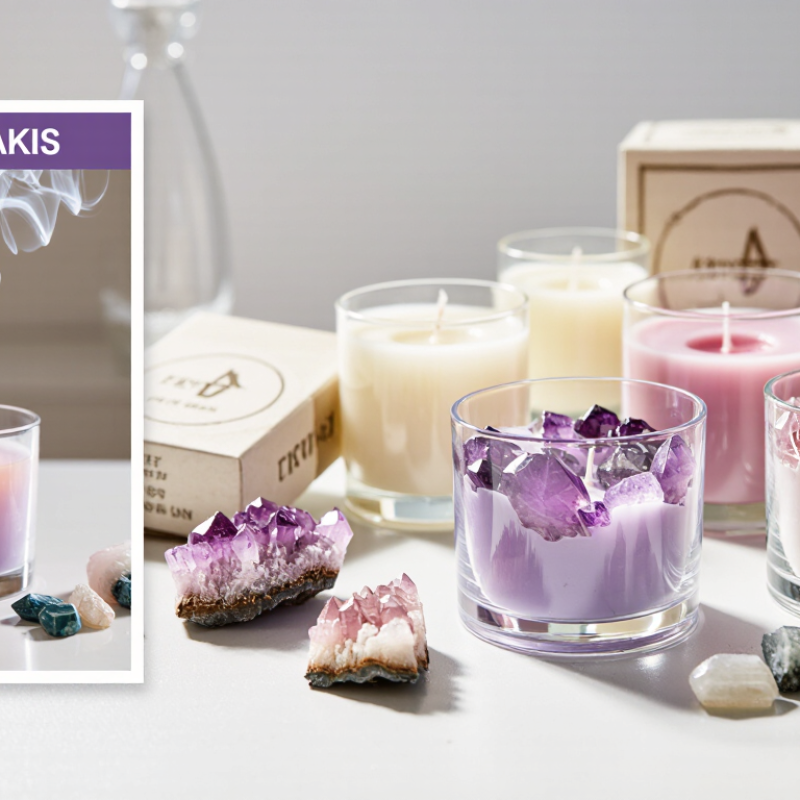
Crystal scented candles combine decorative stones, fragrance, wax, and a suitable container. In wholesale purchasing, each element affects product value and customer safety. A crystal does not prove healing benefits. Its main role should remain visual and tactile.
Choose stones with stable surfaces and no sharp edges. Ask suppliers about stone cleaning, heat resistance, and placement inside the candle. Crystals should not block the wick or create uneven burning. Request wax type, fragrance concentration, wick material, and burn-test records. A clear specification sheet is more reliable than attractive product photos.
Wholesale uses include gift shops, wellness-themed stores, event favors, and seasonal home décor collections. Buyers should match scent profiles with customer habits. Lavender may suit evening products, while citrus often feels brighter for kitchens or spring displays. Test a sample in a quiet room. Check scent strength, melt-pool behavior, smoke, label readability, and packaging damage after shipping.
Small details matter. A loose stone can become a complaint. A weak carton can ruin a full shipment. Minimum order quantities, lead times, replacement policies, and private-label options also deserve written confirmation. Some suppliers provide polished presentation but limited testing evidence. That gap needs attention. Even experienced buyers can overlook it. Recheck the product before scaling the order.
Choosing Crystal Types, Fragrances, and Candle Designs
How to Choose Crystal Scented Candles for Wholesale?
Crystal selection should match the product’s purpose and price tier. Clear quartz suggests simplicity and clean styling. Amethyst offers a purple accent for wellness-focused collections. Rose quartz creates a soft, giftable appearance. Avoid promising healing results. Those claims need stronger evidence and may mislead buyers. Inspect each stone for sharp edges, dust, and loose fragments before production. A safer design keeps crystals near the surface, not touching the wick.
Fragrance needs practical testing. Lavender and vanilla suit relaxing home settings, while citrus and cedar feel fresher and more gender-neutral. Test cold throw, hot throw, and scent strength after burning for two hours. Fragrance preferences vary by region, so wholesale samples matter. Grand View Research valued the global scented candle market at approximately USD 2.2 billion in 2023. Its report also projects continued growth through 2030. That growth does not guarantee every scent will sell. My own caution: attractive crystals cannot rescue a weak fragrance.
Tips: Order small batches first. Compare three crystal sizes and two wick options. Record melt-pool width, burn time, jar temperature, and customer comments. Keep designs visually balanced. A heavy crystal cluster may look luxurious but can reduce usable wax space. The National Candle Association identifies fragrance as a major purchase consideration, supporting a fragrance-led testing process. Choose cotton, wood, or other tested wicks based on vessel diameter. Some early samples may fail. That is useful evidence, not wasted stock.
Evaluating Wax, Wicks, Burn Quality, and Safety Standards
For wholesale crystal scented candles, request a wax specification, wick details, and burn-test records for the finished product. Soy, paraffin, and blended waxes behave differently; compare fragrance release, surface appearance, and residue in the same vessel size. A wick that is too large can produce a tall flame, soot, and excessive heat. One that is too small may tunnel, leaving wax along the crystal walls. Ask suppliers to test complete candles, not just sample wax or fragrance. Small details matter.
Safety deserves equal weight. NFPA’s report Candle Fires in U.S. Home Fires found an estimated 7,610 home structure fires involving candles each year from 2014 to 2018. That figure makes vessel integrity and clear warning labels practical purchasing checks, not paperwork. Request evidence of testing against relevant ASTM specifications, including F2417 for candle fire safety, F2058 for safety labeling, and F2179 for glass candle containers. Crystal-style vessels should be inspected for cracks, uneven bases, and heat damage after repeated burns. Record burn duration, flame height, soot, and container temperature at consistent intervals. Results vary with room airflow, so a single test is not enough. Wholesale decisions can still feel uncertain; transparent records make that uncertainty easier to manage.
Reviewing Packaging, Customization, Shipping, and Quality Control
Wholesale crystal scented candles need more than an attractive jar. Packaging should protect both the glass and any crystal accents during handling. Ask for individual dividers, a snug inner carton, and a drop-test sample before approving a large order. Small details matter. A loose lid or chipped rim can turn a polished product into a costly return.
Customization is easiest to manage when specifications are written down. Confirm fragrance options, vessel color, label dimensions, and logo placement on a signed sample. Request a wax and scent sample too; fragrance can smell different after curing. Keep changes limited once production begins. It may feel restrictive, but last-minute revisions can cause delays and inconsistent batches.
Shipping plans should account for weight, transit time, and seasonal heat. Ask how cartons are palletized and whether tracking is provided. For quality control, agree on checks for fill level, wick position, burn performance, glass defects, and label alignment. If crystal pieces sit near the wax or flame, require documented testing for the finished design. Review a production sample, not just a showroom piece. That distinction is easy to miss. Even a careful supplier may have variation, so define acceptable tolerances before payment and keep inspection records for each shipment.
How to Choose Crystal Scented Candles for Wholesale? This illustrative 1–5 scoring framework highlights factors buyers can assess: product quality, packaging, customization, shipping, and quality control. Scores are a sample evaluation rubric, not survey results or supplier ratings.
