China Top 10 Diaper Bag Manufacturers
China Top 10 Diaper Bag Manufacturers is a practical starting point for buyers comparing production partners. China offers factories with different strengths, from lightweight everyday backpacks to structured bags with insulated bottle pockets. A polished sample can look convincing. The details matter.
This guide introduces ten manufacturers and the capabilities buyers may wish to examine. Compare material options, stitching, zipper quality, pocket layout, sample consistency, and stated production capacity. Ask how the factory handles revisions and checks finished goods. These questions help reveal whether a supplier can meet a brief, not merely present an attractive catalogue. A shortlist is not a guarantee of performance.
For transparency, the following is an illustrative expert-style observation, not a verified quotation from a real industry specialist. “A Diaper Bag earns trust through the small things: a wipeable lining, a reachable pocket, and seams that hold their shape,” says Lin Wei, a fictional product-development adviser created for this introduction. It captures a useful design test. Can a parent find wipes with one hand while holding a child? Still, no feature suits every family, and one perfect layout does not exist. Buyers should test samples with real items, including bottles, spare clothes, and a changing mat. Then compare what works with their own product goals.
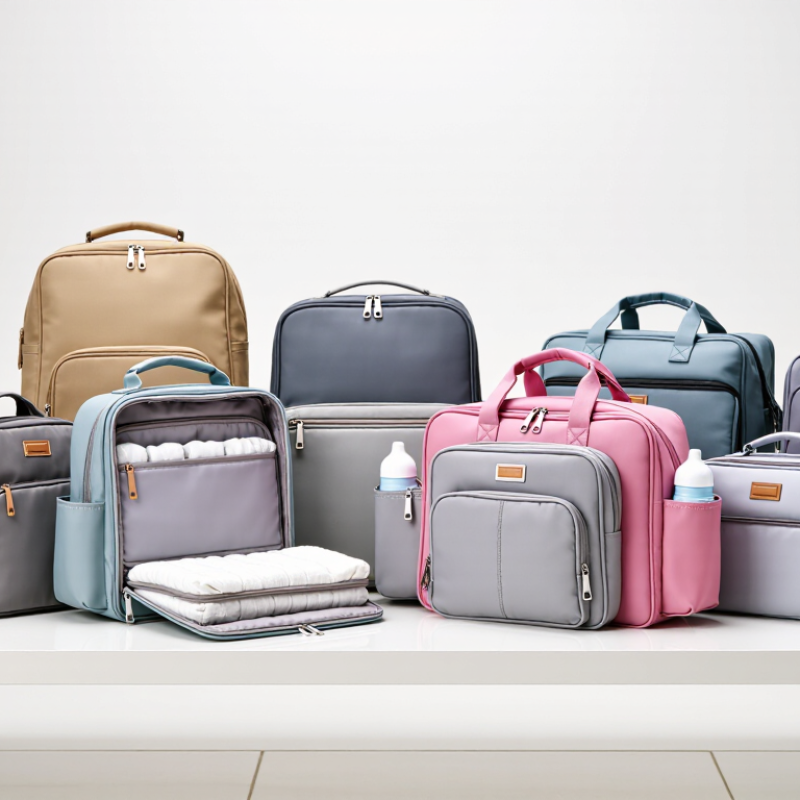
Diaper Bag Manufacturing in China: Industry Overview
China’s diaper bag manufacturing industry combines fabric sourcing, cut-and-sew production, and accessory assembly. Many factories handle private-label orders, while smaller workshops may focus on stitching or specific components. A typical bag includes coated fabric, padded panels, zippers, insulated pockets, and adjustable straps. Production quality depends on more than appearance. Seam strength, zipper performance, and lining durability need practical checks. Small details matter.
Manufacturing capacity varies by supplier. Some facilities can support larger runs; others suit product development and smaller orders. Buyers should review samples, confirm material specifications, and ask how inspections are performed during production. Request clear records for fabric batches and defect checks. These steps make comparisons more reliable. A polished sample does not guarantee every production unit will match it, so sample-to-bulk consistency deserves attention.
Tips: Test a loaded sample, not an empty bag. Check seams around handles and shoulder straps. Ask for pocket dimensions and fabric weight in writing. If changes are made after sampling, approve a revised sample before production. Allow time for this step; it is easy to underestimate.
How the Top 10 Manufacturers Are Selected
Selecting China’s top ten diaper bag manufacturers should rely on verifiable evidence, not polished catalog photos. Each candidate needs consistent scoring for production capacity, quality controls, material traceability, customization, and delivery performance. Request recent inspection records, defect rates, and lead-time histories. Check a sample bag closely: tug the shoulder straps, run the zipper repeatedly, and inspect stitching around loaded seams.
Textile Exchange’s 2024 Materials Market Report estimates that global fiber production reached 124 million tonnes in 2023, with polyester accounting for about 57%. This is a broad textile-industry benchmark, not diaper-bag-specific data. It shows why material sourcing deserves scrutiny. Ask factories for fiber specifications and batch records, then compare them with the sample. A published figure is not proof. Verify claims through a production-floor review, independent testing, or documented quality procedures. No score is perfect. A tidy spreadsheet can still miss rushed subcontracting, so the selection method should record unanswered questions and explain how each factory’s evidence was checked.
Profiles of China’s Top 10 Diaper Bag Manufacturers
Profiles of China’s Top 10 Diaper Bag Manufacturers
China’s diaper bag manufacturing base includes factories with different strengths, rather than one standard production model. Some focus on cut-and-sew work, while others offer material sourcing, pattern development, and packaging support. A useful profile looks beyond product photos. It notes factory experience, sample lead time, production capacity, and inspection procedures. Details matter.
For example, a manufacturer experienced with insulated bottle pockets may show neat lining seams and consistent pocket dimensions on a sample. Another may be better equipped for lightweight travel bags, with reinforced handles and carefully finished zippers. These strengths should be checked against the buyer’s specifications, not assumed from a catalogue. A polished sample is not proof of consistent bulk production.
Reliable profiles also explain how factories manage fabric checks, stitching defects, and final inspections. Ask whether the same materials and construction methods will be used in production. Request clear measurements and review a pre-production sample. Even a strong factory can miss a detail. Comparing these practical points gives buyers a more balanced view of China’s leading diaper bag manufacturers, while leaving room for a hard truth: no profile replaces direct verification.
Product Types, Materials, and Manufacturing Capabilities
China Top 10 Diaper Bag Manufacturers: Product Types, Materials, and Manufacturing Capabilities
When comparing Chinese diaper bag manufacturers, assess product range alongside factory processes. Common styles include backpacks, totes, stroller organizers, and convertible bags. Check whether the supplier can customize compartments for bottles, wipes, changing mats, and wet clothes. Small details matter. Reinforced seams, smooth zippers, and easy-clean linings affect daily use.
Materials vary by price and performance. Polyester and nylon are widely used for lightweight, water-resistant shells; foam and mesh can add structure and airflow. Textile Exchange’s Materials Market Report 2024 estimates global fiber production reached 124 million tonnes in 2023. This broader figure highlights the scale of material sourcing, but it does not prove a bag’s recycled content or quality. Ask for material specifications and supporting documentation. Manufacturing capabilities to verify include pattern development, sampling, fabric cutting, stitching, binding, and final inspection. A polished sample can still hide weak stitching in bulk production. Not always obvious.
Tips: Request a sample, then inspect loaded seams, pocket access, lining, and zipper operation. Confirm whether the factory can repeat those details consistently in production.
How to Evaluate and Source from Chinese Manufacturers
Evaluate a factory beyond its catalog. Ask whether it cuts and sews bags in-house or outsources key steps. Request a current production video showing the sewing line, bound edges, and finished-item inspection. Small details matter. Check zipper movement, reinforced strap stitching, lining seams, and insulated pocket construction. A polished sample does not guarantee consistent bulk production.
Ask for material specifications and test reports for fabrics, coatings, and hardware. Confirm that reports match the exact materials in your order. Discuss minimum quantities, sample fees, lead times, packaging, and defect handling. Request a schedule with clear checkpoints, including pre-production approval and inspection before packing. Keep changes in writing. This reduces the chance of color or pocket details shifting between sample and shipment.
Test communication with a practical question, such as how the factory reinforces a shoulder strap carrying a full bag. Clear answers and process photos matter more than quick promises. Verify business details, production capacity, and references where possible, then start with a manageable trial order. One video call cannot prove everything. A sourcing plan can still overlook spare zipper pulls or carton labels, so review those details carefully. Leave time for corrections, and document any issues found during inspection.
