
Choosing a salon furniture supplier in China is not just a price comparison. A styling chair may look polished in a product photo, yet its hydraulic pump, upholstery seams, and base determine how it performs during a busy day. Buyers also need to check customization options, sample policies, production capacity, shipping arrangements, and after-sales support.
Design researcher Don Norman’s observation, “Attractive things work better,” offers a useful lens for salon interiors. It is not a guarantee of product quality, though. For a salon owner, appearance must sit beside practical checks: Does the chair adjust smoothly? Can the basin withstand daily cleaning? Are replacement parts available? Those details can be easy to overlook.
This guide introduces ten China-based suppliers and considers what buyers should verify before requesting a quote. It looks at product range, manufacturing and customization capabilities, communication, and service—not just catalogue images. Supplier information can change, and a strong first impression is not proof of consistent performance. Ask for current specifications, confirm lead times in writing, and request clear product photographs or samples where possible. A careful comparison takes time. Sometimes, the lowest quote still costs more later.
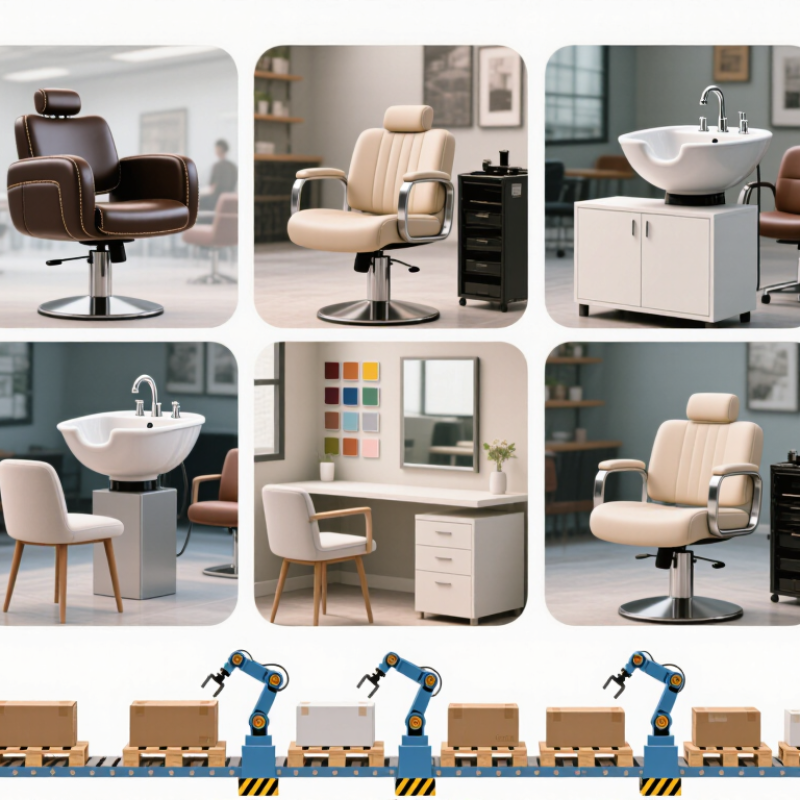
China’s salon furniture supply market is a layered network, not one uniform industry. Some manufacturers focus on a narrow product range, such as styling chairs, shampoo beds, or reception desks. Others coordinate several workshops and assemble complete salon packages. Trading companies may also connect overseas buyers with factories, but their production control can vary. Ask who makes each item. That matters.
Factories often source frames, foam, pumps, upholstery, and hardware from separate local suppliers. This structure can offer choice and flexible specifications, while making quality checks more complicated. A chair may look polished in a catalog, yet its welds, stitching, or lifting mechanism deserve closer inspection. Request material details, production photos, sample checks, and clear packaging specifications before placing a large order. Not always easy.
Export experience is another useful distinction. Established exporters may manage documentation, shipping coordination, and communication across time zones; smaller workshops may provide more direct customization. Neither model guarantees better results. Lead times, replacement-part access, and consistency between samples and bulk orders should be discussed in writing. The market is efficient in places, but fragmented, too. Buyers should compare the supplier’s actual role and capabilities, rather than relying on a broad label such as “manufacturer.”
Who Are the Top 10 Salon Furniture Suppliers in China?
A supplier’s position should rest on evidence, not polished product photos. Check whether salon chairs, shampoo beds, and styling stations use consistent materials and sturdy construction. Ask for frame specifications, weight limits, upholstery details, and warranty terms. Inspect welds and joints closely; uneven finishes can signal inconsistent quality. A clear product sheet matters.
Reliable suppliers explain how they manage customization, production checks, and shipping protection. Request measurements, fabric samples, and photos of finished orders before approving a large purchase. Ask how replacement parts are handled, too. Response time is useful evidence, but it is not enough by itself. A quick reply cannot prove long-term durability.
Tips:
Compare the same chair specifications across several suppliers. Check drawer runners, chair-base stability, and seam stitching in person when possible. Confirm lead times in writing, including sample approval and packaging. A showroom sample can look excellent while bulk production varies. That gap deserves attention, even when the supplier seems professional.
The ten profiles below describe distinct supplier strengths, not a verified ranking. One focuses on hydraulic styling chairs, with attention to pump stability, upholstery seams, and base finish. Another specializes in shampoo stations, where basin depth and neck-rest comfort matter during long appointments. A cabinetry supplier may offer compact drawers for tools and color supplies. Fit matters. A fourth makes manicure tables with built-in ventilation options; buyers should check noise levels and filter access.
A mirror-focused supplier can provide different frame finishes and mounting styles, while a waiting-area specialist may produce benches and reception seating in coordinated materials. One workshop emphasizes modular salon layouts, useful when floor plans change. Another handles custom woodwork, though color samples can look different under salon lighting. A metal-frame producer may serve buyers seeking durable chair bases or trolley structures. Ask about load testing. Details are easy to miss.
The tenth profile is a full-service exporter combining chairs, wash units, mirrors, and storage in one order. This can simplify coordination, but quality may vary across product categories. Request current product specifications, material samples, packaging details, and clear lead times. Check a sample chair yourself: adjust the pump, inspect the stitching, and test the footrest. A polished catalog helps, but it cannot replace hands-on checks. Even careful buyers sometimes overlook small fittings.
China’s salon-furniture suppliers differ less by catalog size than by how well their product ranges work together. A complete offer may include hydraulic styling chairs, shampoo stations, stools, trolleys, mirrors, and reception desks. Check upholstery, pump capacity, basin dimensions, and replacement-part availability—not only showroom photos. Small details matter. A chair that crowds a narrow wash area can force costly layout changes.
Demand is growing, but market growth is not a purchasing forecast. Fortune Business Insights’ Salon Services Market report valued the global market at USD 215.65 billion in 2023 and projects USD 383.88 billion by 2032. This points to opportunities for suppliers that can maintain consistent finishes across repeat orders. It does not prove that any individual factory can deliver reliably. Request dated production samples and inspection records.
Compare customization in measurable terms: minimum order quantities, upholstery options, color cards, logo placement, carton dimensions, and approval lead times. For export capability, ask for packing photos, loading plans, spare-parts lists, and recent shipment references. Confirm who prepares shipping documents and how defects are handled after delivery. Some suppliers promise too much. A factory visit helps, but it cannot replace written specifications and signed sample approval.
Supplier-level rankings and capabilities cannot be verified from the information provided. To avoid inventing company data, this table is a comparison template: confirm each item directly with prospective suppliers before making purchasing decisions.
| Comparison Entry | Product Range to Check | Customization to Confirm | Export Capability to Verify | Evidence to Request |
|---|---|---|---|---|
| Supplier 1 | Salon chairs, styling stations, shampoo units, and accessories: confirm current catalog. | Ask about upholstery, colors, dimensions, materials, and minimum order quantities. | Confirm destination markets, shipping terms, lead times, and export documentation. | Product catalog, quotations, and recent shipment references. |
| Supplier 2 | Barber chairs, barber stations, mirrors, and waiting-area furniture: verify availability. | Check options for upholstery, frame finish, hydraulic components, and branding. | Ask which countries can be served and whether products ship assembled or flat-packed. | Technical specifications, packing details, and sample-order terms. |
| Supplier 3 | Shampoo chairs, backwash units, wash basins, and related fittings: confirm product scope. | Confirm basin materials, plumbing configurations, chair upholstery, and regional fittings. | Verify overseas installation guidance, replacement parts, and shipping arrangements. | Drawings, installation instructions, warranty terms, and parts list. |
| Supplier 4 | Styling stations, worktops, mirrors, trolleys, and storage: request an up-to-date range. | Ask about cabinet sizes, finishes, drawer layouts, electrical options, and logo placement. | Confirm carton dimensions, palletization, and export packaging standards. | Product measurements, packaging photos, and a written customization specification. |
| Supplier 5 | Beauty beds, treatment chairs, stools, and spa furniture: confirm models and intended use. | Check dimensions, adjustment functions, upholstery choices, and electrical specifications. | Verify voltage compatibility, applicable compliance documents, and service support. | Electrical data, test reports where applicable, and warranty coverage by market. |
| Supplier 6 | Manicure tables, pedicure chairs, nail stools, and salon storage: check product availability. | Ask about table dimensions, surface finishes, color choices, and optional fittings. | Confirm shipping protection for glass, ceramic, or other fragile components. | Packing test information, spare-parts policy, and product-care instructions. |
| Supplier 7 | Reception desks, waiting chairs, benches, and lobby furniture: confirm catalog coverage. | Check made-to-measure options, materials, finishes, and project-order requirements. | Ask about consolidated shipments and coordination of multi-item orders. | Project references, dimensioned drawings, and delivery schedule. |
| Supplier 8 | Salon trolleys, stools, footrests, and small equipment: verify models and materials. | Confirm colors, wheel types, dimensions, load limits, and private-label options. | Check whether small items can be included in mixed-product export orders. | Material specifications, load ratings where relevant, and sample availability. |
| Supplier 9 | Salon furniture sets and coordinated product collections: establish what is made in-house. | Ask whether finishes and dimensions can be coordinated across a complete order. | Verify production capacity, order consolidation, and delivery milestones. | Factory audit information, production schedule, and order-level quality plan. |
| Supplier 10 | Mixed salon and beauty furniture range: confirm which categories are regularly produced. | Document feasible custom work, tooling charges, approval samples, and order minimums. | Confirm export experience, payment terms, shipment options, and after-sales process. | Business credentials, references, final specification, and signed quotation. |
Choosing a salon furniture supplier in China takes more than comparing catalog prices. Grand View Research valued the global hair salon services market at USD 215.65 billion in 2022 and projected an 8.0% compound annual growth rate through 2030. The U.S. Bureau of Labor Statistics also projected 8% employment growth for personal care and service occupations from 2023 to 2033. These figures suggest continued demand, but they do not guarantee a supplier’s quality. Ask for a current factory audit, production photos, and references for comparable orders. Details matter.
Inspect a sample chair closely. Check the stitching, frame joints, upholstery edges, and whether the hydraulic pump lowers smoothly under weight. Request material specifications, test records, and written confirmation of dimensions, carton protection, lead time, and spare-part availability. Confirm what happens if a shipment arrives damaged. A low quote can become expensive when packaging or replacement parts are overlooked. I would not treat a polished showroom sample as proof of consistent mass production. If possible, inspect a finished unit from a recent batch, and keep every agreed specification in writing.
Compare supplier drawings and product specifications against these indicative planning dimensions. Actual sizes vary by design, model, and manufacturer.
Use these ranges as a starting point when checking product fit, installation clearances, and customization options with suppliers. Confirm final dimensions on each product drawing before ordering.