What Are the Top Vinyl Player Turntable Types in 2026?
A turntable is not just a platter and a tonearm. It is a small mechanical system: the cartridge traces a groove, the stylus follows its walls, and the speakers reveal every setup choice. In 2026, choosing a Vinyl Player Turntable means weighing sound, convenience, upgrade options, and the space available at home. Some listeners want a simple automatic deck. Others prefer a manual model with a heavier plinth and a replaceable cartridge. Neither choice is automatically better.
The market remains substantial. The Recording Industry Association of America’s 2024 Year-End Revenue Report put U.S. vinyl revenue at $1.4 billion, up 6% from 2023. That figure signals continuing demand, though it does not tell buyers which type suits them. Details matter. A belt-drive model can reduce motor vibration at the platter; direct drive offers quick, steady starts and is common in DJ setups. Built-in phono preamps can simplify connections, while separate components allow more upgrades.
As RIAA Chairman and CEO Mitch Glazier said in the association’s 2024 year-end announcement, “Vinyl continues to be a bright spot for the music industry.” It is a useful market observation, not a promise of perfect sound. A poorly aligned cartridge can still make a premium deck disappointing. This guide compares the leading turntable types for 2026, from entry-level automatic players to manual audiophile and DJ-focused designs. Expect practical trade-offs. The best type is the one you will set up correctly, use often, and enjoy listening to.
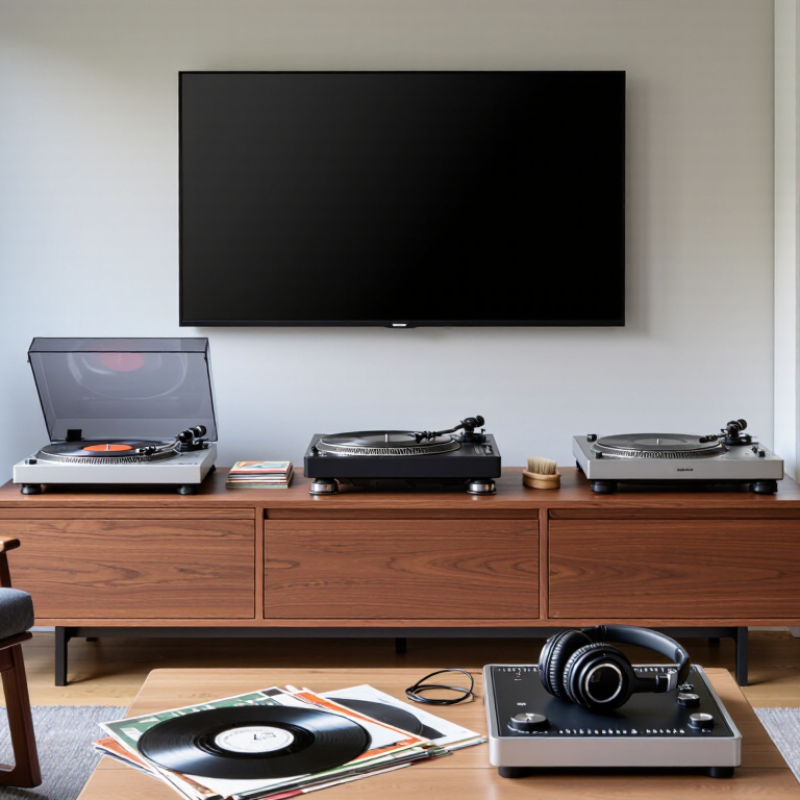
How Turntables Are Classified by Drive System and Operation
Turntables are commonly grouped by how the platter receives power. In a belt-drive design, a flexible belt connects the motor to the platter. The motor is usually set off to one side, while the belt loops around the platter’s inner rim. This arrangement can help isolate motor vibration, though a worn belt may cause speed drift. Check that it sits evenly.
Direct-drive models connect the motor more closely to the platter. They often reach playing speed quickly and hold it steadily, which is useful when starting and stopping records often. Some designs use an idler wheel between motor and platter; these can offer strong torque, but condition and maintenance matter. The categories are helpful, not perfect. Construction varies.
Operation provides another way to classify a turntable. A manual model requires the listener to place the tonearm on the record and lift it afterward. A semi-automatic model may return or stop the arm at the end, while a fully automatic model handles arm movement with a control. Automatic systems add convenience, but more moving parts can mean more adjustment points. On a quiet evening, the difference is practical: one setup asks you to stay nearby; another lets you settle back. Neither system guarantees better sound. Cartridge alignment, stylus condition, and a level surface matter too.
What Are the Top Vinyl Player Turntable Types in 2026? — How Turntables Are Classified by Drive System and Operation | Drive System | Operating Type | How It Works | Typical Advantages | Considerations |
| Belt drive | Manual | A motor turns the platter through an elastic belt. The listener positions the tonearm and returns it at the end of playback. | Simple operation and a widely used design; the belt separates the motor from the platter. | The belt can stretch or wear and may need replacement. Speed selection or platter-start procedures vary by model. |
| Belt drive | Semi-automatic | The listener places the tonearm on the record. At the end of the side, a mechanism typically lifts the tonearm or stops the platter. | Combines manual cueing with some end-of-record assistance. | “ Semi-automatic” features vary: some models lift the arm, while others only stop the platter. |
| Belt drive | Fully automatic | A start control triggers a mechanism that moves the tonearm to the record; the mechanism returns or lifts it at the end. | Convenient for hands-off starting and end-of-side operation. | The tonearm mechanism adds mechanical complexity, and automatic functions depend on the individual design. |
| Direct drive | Manual | The motor drives the platter directly, without a belt. The listener cues and returns the tonearm by hand. | Quick start-up and stable speed control are useful for repeated cueing and hands-on playback. | Performance depends on motor and platter design; direct drive alone does not determine sound quality. |
| Direct drive | Semi-automatic | The platter is motor-driven directly, while an end-of-record feature may lift the tonearm or stop playback. | Pairs direct-drive operation with limited automatic assistance. | End-of-side functions are model-specific and should be checked before purchase. |
| Direct drive | Fully automatic | The direct-drive platter is paired with a mechanism that starts playback and handles tonearm return or lift at the end. | Offers automatic operation alongside a motor system that does not rely on a drive belt. | Availability and automatic features vary; serviceability depends on the design and parts support. |
| Idler-wheel drive | Usually manual; automation varies | A rubber-edged wheel transfers rotation from the motor to the inner rim of the platter. | A distinct drive design found in some classic and specialist turntables. | Idler condition and adjustment can affect noise and speed behavior; replacement parts may be less readily available. |
How to read the classifications: Drive system describes how motor power reaches the platter; operating type describes how much the turntable automates starting, tonearm movement, and end-of-record handling. These are separate characteristics, and not every combination is commonly available.
Belt-Drive Turntables: Design, Strengths, and Limitations
Belt-drive turntables use an elastic belt to connect the motor to the platter. The motor sits apart from the platter, often beneath the plinth, while the belt loops around the platter’s inner rim. This simple separation can reduce motor vibration reaching the stylus. On a quiet recording, that may mean less low-level mechanical noise. The effect depends on the whole design, not the belt alone.
The belt can also soften sudden motor changes, helping playback feel smooth. But it may stretch or harden with age. A worn belt can cause slow startup, unstable pitch, or a platter that takes too long to reach speed. Check that the belt sits flat, with no twists, and replace it if it feels slack or looks cracked. Small details matter.
Belt-drive models often suit home listening, especially when the turntable rests on a stable, level surface. Yet they are not automatically quieter or more accurate than every direct-drive design. Motor quality, platter balance, bearing condition, and setup all count. Belt replacement is a minor chore, but an easy one to overlook. Listening for wavering sustained notes can help reveal speed problems.
Direct-Drive and Idler-Drive Turntables: Key Differences
Direct-drive and idler-drive turntables move a platter in different ways. A direct-drive motor sits beneath the platter and turns it directly. This design can reach playing speed quickly and maintain steady rotation, which is useful when cueing records or changing between speeds. Setup is often straightforward. Still, motor vibration can travel through the platter if the design and isolation are poor, so construction matters more than the label alone.
An idler-drive turntable uses a rubber wheel between the motor spindle and the platter’s inner rim. The wheel transfers power with substantial torque, giving some models a lively, firm start. Its condition matters. Rubber can harden or develop flat spots, and worn parts may add hum or rumble that becomes noticeable in quiet passages. A careful inspection should include the wheel’s surface, platter movement, and sound from the motor area. Repairs can require more hands-on work.
For everyday listening, consider speed stability, noise, serviceability, and the condition of the specific unit. A well-maintained idler drive can perform beautifully; a neglected one may not. I would not choose by mechanism alone. Auditioning with a familiar record helps, though room noise can hide subtle differences. Some judgments are imperfect. That is worth remembering.
Manual, Semi-Automatic, and Fully Automatic Turntables
Manual, semi-automatic, and fully automatic turntables differ in how much work they ask of the listener. With a manual model, you lift the tonearm, position the stylus over the record’s lead-in groove, and raise it again when playback ends. That direct control can feel engaging, but a rushed hand can drop the stylus too hard. A steady touch matters.
Semi-automatic models handle one part of the process, usually lifting the tonearm or stopping the platter at the end of a side. You still place the stylus to begin playback. This middle ground suits listeners who want some hands-on involvement without needing to stay nearby for every final groove. Check the specific mechanism before buying: “semi-automatic” features can vary.
Fully automatic turntables typically start playback and return the tonearm with a button press. They can be useful when reaching across a cabinet is awkward, or when you want less handling around the stylus. Their added mechanisms may make setup or repairs more involved, though that depends on the design. None is automatically best. Match the operation to your habits, and consider whether you prefer careful manual handling or a simpler start-and-stop routine. Even a convenient control can feel unnecessary once it becomes part of the furniture.
What Are the Top Vinyl Player Turntable Types in 2026?
Manual, Semi-Automatic, and Fully Automatic Turntables
The chart compares two common convenience functions: automatic tonearm start and automatic end-of-record action, such as lifting the tonearm or stopping the platter. These are typical distinctions, not guarantees; features vary by model.
Portable, All-in-One, and Component Turntable Systems
What Are the Top Vinyl Player Turntable Types in 2026? Portable, All-in-One, and Component Turntable Systems
Portable turntables suit listeners who value easy setup and room-to-room use. Many include speakers, a built-in preamp, and a protective lid. Their small cabinets can sound lively, but tiny speakers may struggle with bass and volume. All-in-one systems also combine key parts, often adding stronger speakers and straightforward controls. They work well in a bedroom or first apartment, though upgrades may be limited. The Recording Industry Association of America reported that U.S. vinyl revenue reached $1.4 billion in 2024, its 18th consecutive year of growth. That figure measures record sales, not turntable sales, but it signals continued interest in listening on vinyl.
Component systems separate the turntable, amplifier, and speakers. This setup takes more space and usually costs more, yet lets listeners replace or improve individual parts. A separate speaker pair can create a wider, more detailed soundstage than compact built-ins. Setup matters: place the turntable on a stable surface, keep it away from speaker vibrations, and check cartridge alignment. Small errors can affect playback. I learned that “more gear” does not automatically mean better sound; room placement can matter just as much.
Tips: Choose portable for mobility, all-in-one for simplicity, and components for flexibility. Check whether a model has a built-in phono preamp before buying an amplifier. Leave room for speaker stands, cables, and record storage. If possible, listen before purchasing; specifications alone cannot predict how a system will sound in your room.
